
What Your Body Remembers From 20 Years Ago

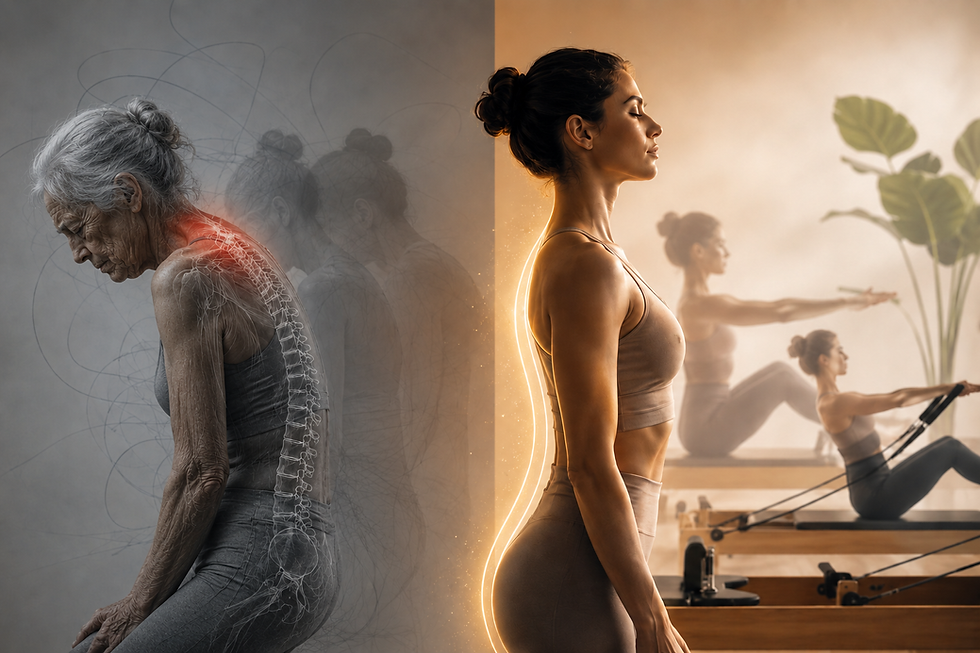
Movement memory, emotional posture, and how Pilates rewrites patterns
Your body is a historian. Not the dusty-library kind. More like wet cement that quietly hardened around thousands of repetitions.
The way you stand while brushing your teeth. The shoulder that always lifts first. The jaw that tightens during stress. The hip that turns out when you walk. Many of these patterns were not created yesterday. Some were written decades ago.
Long before we consciously notice them, our bodies begin building movement habits through repetition, emotion, injury, environment, and identity. A dancer moves differently from an accountant. A mother differently from a teenager. A person who spent years feeling “on guard” may unknowingly carry that posture into every room they enter.
The fascinating part is this: the body can learn new stories too.
At Elevate Pilates, this idea sits at the heart of how we teach movement. Pilates is not simply about stretching tighter muscles or strengthening weaker ones. It is about bringing awareness to patterns that have become so familiar they feel invisible.
Sometimes, what aches is not just a muscle. It is a decades-old strategy.
The Body Learns Through Repetition
Science increasingly supports what movement practitioners have observed for years: repeated movement changes the brain.
Research into neuroplasticity shows that mindful movement practices can alter neural pathways, improve motor control, and even influence emotional regulation.
Dance studies are particularly interesting here. Long-term dance training has been shown to affect brain structure, coordination, memory, and sensory integration.
That means the body you have today is partly shaped by the movements you repeated years ago.
For the directors of Elevate Pilates, this is deeply personal.
Before Pilates, both Carlo and David trained extensively in ballet. Ballet leaves fingerprints on the body. Beautiful ones, yes, but also demanding ones.
Years of striving for turnout, extension, precision, and aesthetic perfection create extraordinary body awareness. But they can also create deeply ingrained compensations. Even now, decades later, certain movement tendencies remain.
A turned-out standing posture. Overworking through the lower back. Holding tension through the neck during effort. The impulse to “perform” movement instead of simply experiencing it.
Former dancers often carry invisible choreography into ordinary life.
And yet, both Carlo and David openly acknowledge that mindful movement remains part of their own ongoing process. Pilates is not something they “graduated” from. It is something they continue to return to, refine through, and learn from.
That is perhaps one of the most human aspects of movement work: the teachers are still listening to their own bodies too.
Emotional Posture Is Real
Posture is not just structural. It is emotional.
Anyone who has walked into a stressful meeting already knows this intuitively. The shoulders narrow. The breath shortens. The chest collapses slightly inward. We physically organize ourselves around experience.
Research on body memory and kinesthetic feedback suggests that movement and posture can influence cognition, emotional state, and memory recall.
In simpler terms: the way we move affects the way we feel, and the way we feel affects the way we move.
This does not mean emotions are magically trapped inside muscles like old files in a cabinet. The science is more nuanced than that. Increasingly, researchers view posture and tension patterns as outputs of the nervous system’s predictions and protective habits.
Think of it like a playlist the nervous system keeps replaying because it believes the song is still needed.
Someone who spent years under pressure may unconsciously brace through the ribcage and neck. Someone who trained in high-performance sport or dance may grip through the hips or jaw even during rest. These patterns become “normal” simply because they are familiar.
The body remembers what it practiced most.
Pilates as a Rewrite, Not a Punishment
This is where Pilates becomes powerful.
Not because it aggressively “fixes” the body, but because it interrupts automaticity.
A well-taught Pilates session asks questions the body has not heard in years:
Can your shoulders move without your neck helping?
Can your hips stabilize without gripping?
Can you breathe fully while under effort?
Can you move with control instead of force?
Can you notice tension before it becomes pain?
At first, these changes can feel strangely unfamiliar. Sometimes even uncomfortable. That is because the nervous system often prefers familiar patterns, even inefficient ones.
But repetition matters.
Over time, mindful movement creates new sensory input. New coordination. New awareness. New options.
Studies on balance training and mindful exercise show improvements not only in physical performance but also in cognition and neural adaptability.
This is why Pilates often feels different from conventional exercise. It is less about punishing the body into submission and more about teaching the nervous system safer, more efficient possibilities.
Less bootcamp. More recalibration laboratory.
Your Past Does Not Have To Become Your Future
The body remembers.
But thankfully, it also adapts.
The posture you developed at 19 does not have to define you at 49. The tension pattern you built during stressful years does not have to become permanent architecture.
Awareness changes movement. Movement changes experience. Repetition changes the nervous system.
That process takes patience. Curiosity. Consistency.
And perhaps most importantly, compassion toward the body that got you here in the first place.
If this article resonated with you, share it with someone whose body might still be carrying old stories.
And if you are ready to begin rewriting some of your own movement patterns, book a session with Elevate Pilates. Your body has been speaking for years. Pilates helps you finally hear the conversation.


Comments